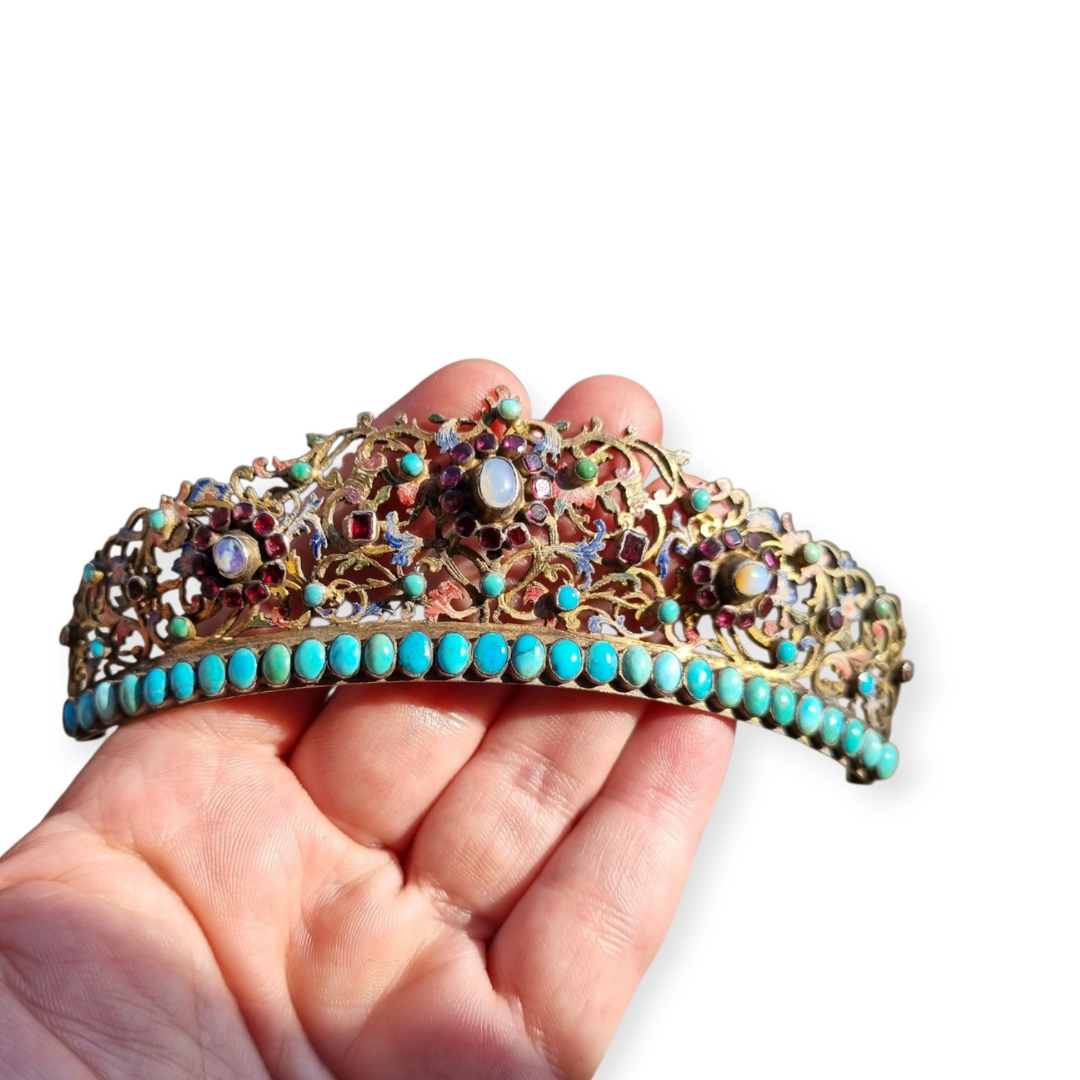
Exceptional late 19th-century Victorian tiara made of gilded silver, with a rigid arched structure designed to be placed over the front or top of a hairstyle. It features a curved lower band that follows the shape of the head and side terminals to facilitate its attachment to the hair using hairpins, ribbons, or other fastening systems.
The entire front part is formed by an elaborate openwork framework of scrolls, stems, leaves, and small flowers. The decoration combines numerous turquoise cabochons, faceted garnets, moonstones, and polychrome enamel preserved in blue, rose-red, and green tones. A continuous row of turquoises runs along the base of the tiara, creating a distinct line of color against the hair.
The composition is organized around three large floral motifs. Each features an opalescent moonstone in a central position surrounded by garnets, while small turquoises and other reddish stones are distributed among the openwork foliage. The contrast between the gold of the silver, the blue of the turquoises, the red of the garnets, and the nacreous opalescent reflections of the moonstones gives the piece a particularly rich appearance when viewed from the front.
The reverse is also carefully worked. The vegetal openwork continues throughout the structure and allows observation of the independent construction of the main settings, characteristic of a piece conceived as a complete formal jewel and not as a simple decorative element applied to a base.
Due to its shape, size, and construction system, its function corresponds to a tiara or formal female head ornament, intended to be worn integrated into an elaborate hairstyle. This type of ornament could be used at receptions, balls, formal dinners, family celebrations, ceremonies, and other social events where attire required jewels of special presence. It could also form part of a bridal or ceremonial outfit, although without documented provenance, it is not possible to assert a specific wedding use for this piece.
Its ornamental richness, chromaticism, and ceremonial character place it within late Romanticism and the fin de siècle taste of the late 19th century. It can also be contextualized within what is known as continental Victorian jewelry, using the term Victorian as a chronological and aesthetic reference and not as an indication of British manufacture.
The combination of gilded silver, polychrome enamels, turquoises, garnets, and moonstones shows a particular affinity with historicist Austro-Hungarian jewelry of the second half of the 19th century. By construction, materials, and decorative repertoire, its origin is probably in Central Europe, within the Austro-Hungarian sphere
-
Period: Late 19th century
- Style: Late Romantic / fin de siècle / continental Victorian, with
-
Neo-Renaissance influence
-
Origin: Central Europe, probable Austro-Hungarian sphere
-
Circa: 1880–1900
-
Materials: Tested gilded silver, turquoises, garnets, moonstones, and polychrome enamel
-
Hallmarks or Punches: No territorial punch or manufacturer's mark identified
-
Acid test: Performed
-
Measurements: 13 cm wide × 3.3 cm max height
- Weight: 30.46 g
Condition: Good condition in accordance with its age. The piece retains an attractive historical patina, much of the gilding, its stones, and remnants of polychrome enamel. It shows small signs of use, slight losses of enamel, and natural variations in tone in the turquoises, characteristics that are part of its antique character. As is common in jewelry from this period without a documented intervention history, some stone or small element may have been readjusted or replaced during its lifetime. Please examine the photographs carefully and, if you wish to confirm any specific detail, we will be happy to assist you before purchase.